It was pitiable to see the civilians come in. Mothers and fathers had children in their arms or clinging to their hands; others supported men who had suffered at the hands of the Japanese. We were lined up along the roadside and could not help them or speak to them until they had been checked in.
The civilians included American and British Protestant missionaries and British, Dutch, and Belgian business men and their families. There were engineers from the coal mines to the north, personnel from the foreign banks in Peiping, Tientsin, and other cities. There was an American man with his two half-Japanese daughters. Though his Japanese wife and their two sons requested to be allowed to go with the husband and father, the Japanese authorities insisted that they were not interning their own nationals, so this family was broken up .
There were Chinese and Indians who, because of birth in a British territory, held British citizenship. There was an American with his Mongolian wife and seven children. There were women who had never done an hours work in their lives: there were women who couJd not understand their own children for the children had been raised by Chinese amahs (women servants) and spoke only Chinese: there were women whose husbands waited on them, washed their clothes. These women remonstrated with the sisters when they saw the sisters washing and ironing and mending the priests' clothing.
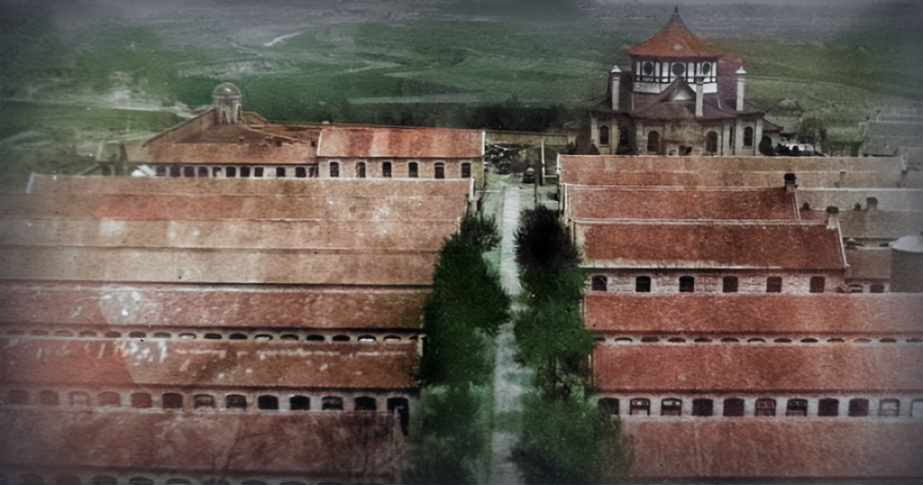
There were, in short, many types and kinds of people. The final count of internees at Weihsein was near two thousand, of which four hundred ten were priests and brothers and one hundred sixty were sisters.
Each group of arrivals in the camp was asked to designate one member to represent the group to the authorities. Our group of missionaries chose Father Francis Clougherty. 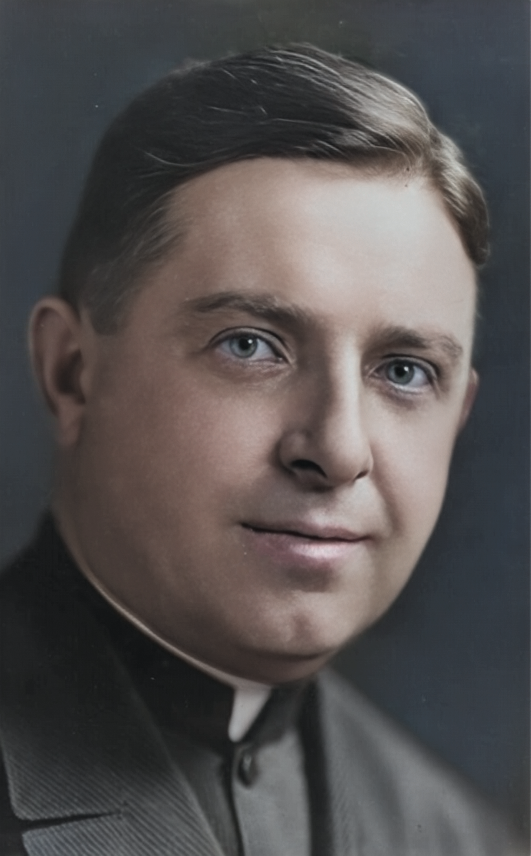 As other groups came, they chose their leaders. From these leaders there was formed a committee to run the camp. Committee members negotiated with the Japanese; they decided problems of housing; they made out work schedules: they decided what things needed doing and set out to find ways and means of getting them done. This often put them in a cross fire between Japanese demands and the internees' complaints. Even a policeman was appointed with all the powers that could be given him under such circumstances.
The people were divided into three groups according to the part of North China they had been brought from, and each group ran its own kitchen and dining room. Everything else was handled in common. Everyone had to do a certain amount of generaJ work for the welfare of all. Not even the care of young children excused a mother from doing her share of this work. Some of the sisters had the job of rounding up young children and taking them to the playground for a few hours, thus leaving the mothers free to do their appointed tasks. Classes were organized for the grade school children and most of the teachers were sisters.
Life was a never-ending round of chores.
Engineers got to work to make necessary repairs and to put in necessary fixtures. The water problem was serious and had to be solved if the inmates of the camp were not to die of water-borne diseases. A large group of people depended on a few shallow wells full of surface water. To be safe for drinking, this water had to be boiled, but the Japanese had made no provisions for this. Among the debris in the yards were boilers and plumbing fixtures of various kinds that the Japanese had ripped out of the buildings. The engineers salvaged these and soon had a system for each kitchen to supply the people with boiled water. These were makeshift, often primitive arrangements but they filled a need.
Another group, led by a priest who had been a baker before he was a priest, tore down the ovens the Japanese had installed for the baking of bread and rebuilt them so that the men could bake bread for the internees. If there was anything wrong with the bread, it was not the men's fault; the blame was on flour which often contained not a small percentage of sand.